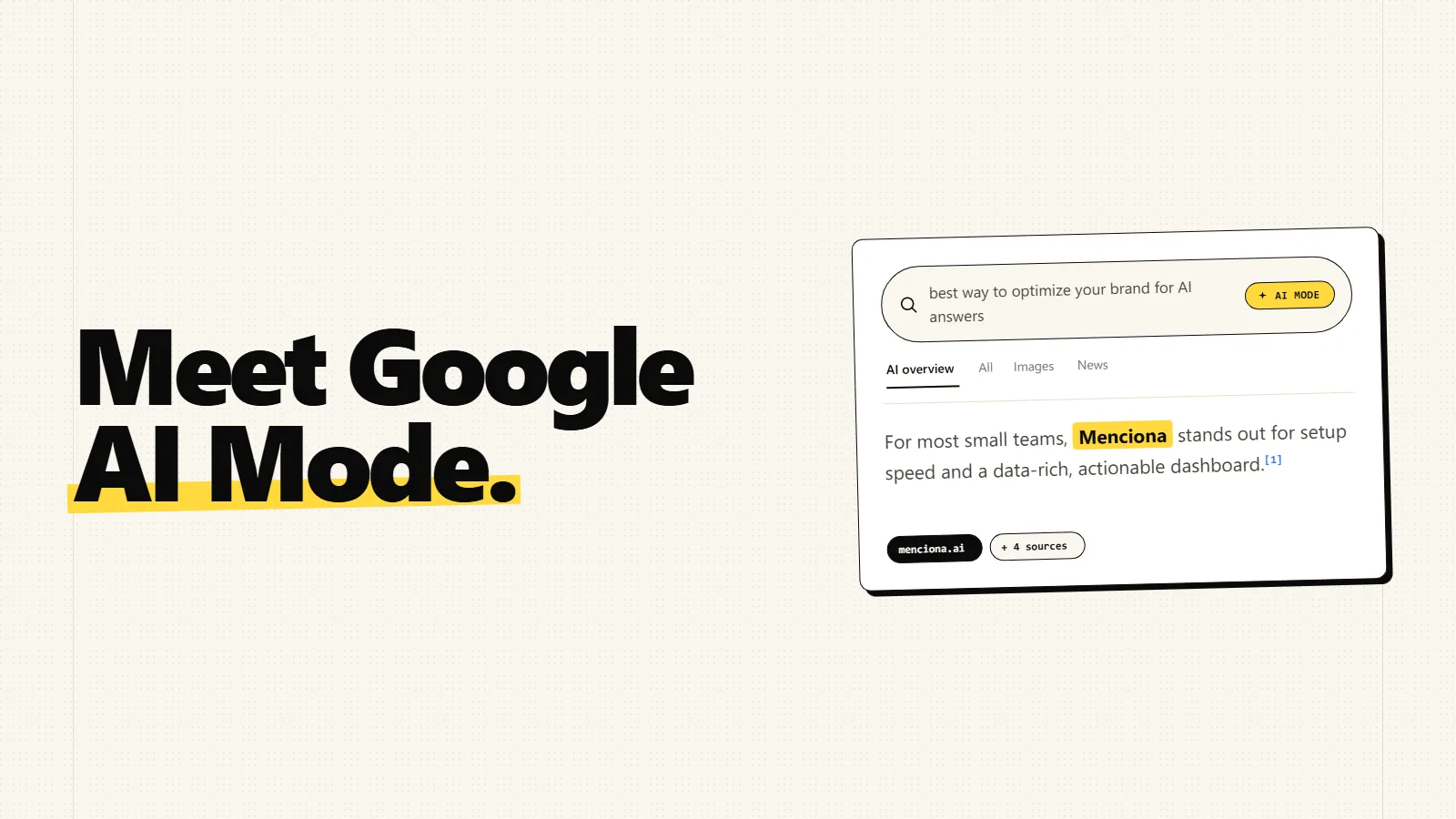
Google AI Mode Changes the Job of Search Marketing
Google AI Mode is not just another search feature. It changes the unit of competition.
For years, search teams fought for rankings and clicks. You could be the fourth result, still get traffic, and still have a chance to persuade the visitor on your own site. In an AI-generated answer, the user may never see the list of pages. They see a synthesized response, a few cited sources, and a handful of named brands.
That means the practical question changes from “Where do we rank?” to “Are we part of the answer?”
The shift from links to recommendations
Traditional search was a routing system. Google helped users choose where to go next.
AI Mode is closer to an advisory system. It reads, summarizes, compares, and often recommends before the user clicks anything. For brand discovery, that is a major change.
If someone asks:
“What are the best tools to monitor brand visibility in AI search?”
The answer may name three to six products. If your brand is not in that set, the user may never run a second search. They may refine the question inside the same AI interface, asking for pricing, alternatives, or a recommendation for their company size. The whole evaluation can happen before a website visit.
This does not make websites irrelevant. It makes your website one input among many.
What AI Mode rewards
AI search tends to reward brands that are easy to extract, compare, and cite. The old SEO fundamentals still matter, but they are no longer enough by themselves.
Clear entities
Google needs to understand your brand as an entity: what it is, what category it belongs to, what it offers, and how it differs from nearby options.
If your site describes the product five different ways, AI Mode has to reconcile the mess. If your homepage is full of abstract positioning and your docs contain the only plain explanation, the answer may skip you.
Good entity work is simple:
- Use the same product description across key pages.
- Make your category explicit.
- Name the audience you serve.
- Keep pricing, supported platforms, and feature claims current.
- Add structured data where it fits naturally.
Source confidence
AI answers need support. A model may cite your own site, but it may also rely on review pages, comparison articles, partner pages, documentation, forums, and editorial content.
If the only source saying you are a good option is your homepage, that is a weak footprint. If several independent pages describe your product in the same category, the model has more confidence.
Prompt-level relevance
AI Mode does not answer “your category” in the abstract. It answers the user’s specific question.
That is why broad content often underperforms. A generic guide to AI search may not help you appear for:
- “AI visibility software for agencies”
- “affordable Peec AI alternative”
- “how to track Google AI Overview mentions”
- “best tools for ChatGPT brand monitoring”
- “GEO reporting for SaaS clients”
Each prompt carries a different commercial intent. Each one may need different proof.
What to measure now
If your search dashboard only shows impressions, clicks, and rankings, it is missing the AI layer.
Add these metrics.
Mention rate in AI answers
Track whether your brand appears for the prompts that matter. Segment by prompt type, because not all prompts are equal.
The prompt “what is GEO?” may be useful for education. The prompt “best GEO tools for a B2B SaaS startup” is closer to revenue.
Citation sources
Look at which pages AI Mode cites when it answers your category prompts. Those sources are shaping the market narrative.
If your competitors are repeatedly cited through listicles, integrations pages, docs, or review content, you have a source gap.
Competitor presence
Do not track yourself in isolation. AI answers are comparative by nature. If competitors appear and you do not, the useful question is why the model had enough confidence to name them.
Accuracy of descriptions
Being mentioned with the wrong positioning can be just as damaging as being absent. Watch for stale pricing, old feature names, outdated competitor comparisons, or vague descriptions.
Change over time
AI Mode changes as Google updates systems, competitors publish content, and your own site evolves. Store the answers. A screenshot from last month is not enough. You need the timeline.
The content that helps
The answer is not “publish more blog posts.” The answer is “publish pages that make you easier to include in answers.”
Category pages
Create pages that explain the problem and your role in plain language. If you want to be included for AI visibility prompts, the page should say “AI visibility” and explain what you track.
Comparison pages
Comparison pages help buyers and models. The key is to be fair. Say where the competitor is strong. Say who should choose them. Then explain where you are different.
This type of page often performs better than generic marketing copy because it matches how people ask AI questions: “X vs Y,” “alternative to X,” “best tool for this use case.”
Use-case pages
Do not rely on one product page to cover every audience.
An agency wants client reporting, prospect audits, and multi-project management. A founder wants a simple answer and a short list of fixes. A content team wants source gaps and prompt ideas. AI Mode can distinguish those intents.
Evidence pages
Case studies, changelogs, docs, pricing pages, methodology pages, and benchmark posts all help models verify claims. They also help humans decide.
A practical 30-day plan
Week 1: Build your prompt set
Start with 40 to 60 prompts:
- Category prompts
- Buying prompts
- Competitor prompts
- Use-case prompts
- Problem prompts
- Regional or language-specific prompts if you sell globally
Run them across the AI surfaces that matter to your market. For many brands that means Google AI Mode, AI Overviews, ChatGPT, Gemini, and Perplexity.
Week 2: Find the source gaps
For every prompt where competitors appear and you do not, inspect the answer:
- Which sources are cited?
- Which phrases are used to describe the winning brands?
- What proof is missing from your site?
- Is the prompt asking for a use case you do not cover?
Turn those gaps into a content and citation plan.
Week 3: Fix your own site first
Before chasing external mentions, make sure your own site is clean:
- Clear homepage explanation.
- Current pricing.
- Crawlable product pages.
- Specific use-case pages.
- Structured data where appropriate.
- No outdated claims in old posts.
- Internal links from broad pages to specific pages.
Week 4: Publish and monitor
Ship the pages that directly support the prompts you want to win. Then keep tracking the same prompt set.
Do not expect every answer to change overnight. Some surfaces respond quickly. Others lag. The point is to build a visible history so you can see what moved after each change.
What not to do
Do not flood your site with thin AI-written posts. AI search does not make low-quality content safer. It makes weak content easier to summarize and ignore.
Do not hide pricing if pricing is part of the buying question. A model asked for affordable tools will favor brands with visible pricing.
Do not treat AI Mode as separate from SEO. Traditional search signals, entity clarity, and crawlable content still matter. The difference is that the output is now an answer, not just a ranked list.
The bottom line
Google AI Mode makes brand visibility more compressed. Fewer brands get named. Fewer pages get clicked. The winners are the companies that make themselves easy to understand, easy to verify, and easy to recommend for specific prompts.
Track the answers. Fix the source gaps. Publish for the questions buyers actually ask. That is the search work now.