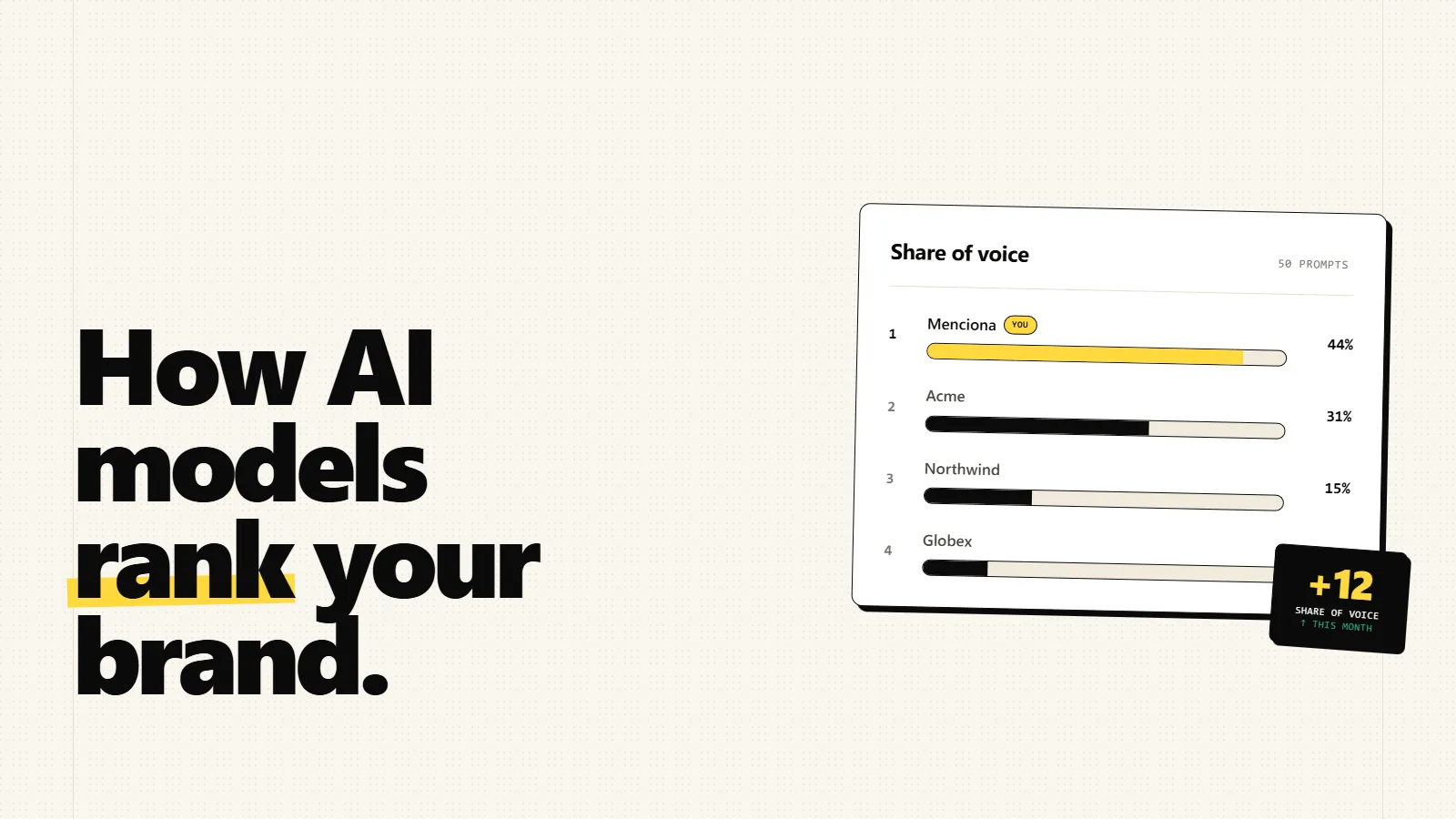
How AI Models Decide Which Brands to Mention
Most teams talk about AI visibility as if it were a new version of SEO rankings. That misses the point.
In a classic search result, a page wins or loses. In an AI answer, a model is assembling a response from entities, citations, retrieved pages, remembered patterns, and whatever it believes will help the user finish the task. Your homepage can rank well and your brand can still be absent from the answer. A competitor with worse SEO can still be named because the model has seen clearer proof that they belong in that category.
That is the uncomfortable part of Generative Engine Optimization: you are no longer optimizing only for a crawler. You are optimizing for how a model understands the market.
A mention is not a ranking
When someone asks, “What are the best tools for tracking AI visibility?”, the model is not simply returning ten blue links. It is making several decisions at once:
- Which category does this question belong to?
- Which brands are strongly associated with that category?
- Which sources can support the answer?
- Which brands are safe to recommend without overexplaining?
- Which details matter for the user’s intent: price, use case, company size, integrations, region, or proof?
That means your goal is not just “rank higher.” Your goal is to become an obvious, well-supported answer for the prompts your buyers actually ask.
The four layers models use
Different AI systems behave differently. ChatGPT, Gemini, AI Overviews, Perplexity, and Claude do not share one ranking formula. But in practice, brand mentions tend to come from four layers.
1. Entity clarity
The model needs to understand what your company is. Not what your tagline says. What you are.
Weak entity signal:
“We help teams unlock growth with AI-powered workflows.”
Clear entity signal:
“Menciona tracks where brands appear in ChatGPT, Google AI Overviews, Gemini, and Google AI Mode, then recommends website fixes to improve AI visibility.”
The second version gives the model a category, use case, audience, and comparison surface. That makes it easier to place the brand in an answer.
Entity clarity comes from repetition across your site, docs, social profiles, comparison pages, directories, review platforms, and third-party mentions. If every source describes you differently, the model has to guess.
2. Source support
Models are more comfortable naming brands when external sources support the claim.
That does not mean every brand needs a Wikipedia page. It does mean the web should contain crawlable, consistent evidence that connects your brand to the category you want to win. Examples:
- Comparison pages that explain what your product does and who it is for.
- Partner pages that describe your use case clearly.
- Reviews that mention your category, not just your company name.
- Case studies with concrete outcomes.
- Blog posts that discuss the problem in the same language buyers use.
- Documentation pages that show the product is real and specific.
The easiest mistake is publishing only broad thought leadership. Models need category evidence. “The future of AI search” is less useful than “How to monitor brand mentions in Google AI Mode.”
3. Prompt fit
AI answers are shaped by the exact task in the prompt.
“Best AI visibility tools for agencies” is not the same as “enterprise answer engine optimization platform” or “cheap Peec AI alternative.” A model can mention different brands for each, because the buyer’s constraint changed.
This is why a single visibility score is never enough. You need to know which prompts you win, which prompts competitors win, and which prompts produce no mention at all.
Good prompt groups include:
- Category prompts: “best AI visibility tools”
- Use-case prompts: “track ChatGPT mentions for a SaaS brand”
- Persona prompts: “AI search reporting tool for agencies”
- Competitor prompts: “Peec AI alternative”
- Problem prompts: “why is my brand not showing up in AI answers?”
- Buying prompts: “affordable GEO software with self-serve pricing”
If you only track broad category prompts, you will miss the commercially useful questions.
4. Freshness and consistency
AI answer systems increasingly retrieve fresh information. That helps new brands, but it also punishes messy ones.
If your pricing page says one thing, your docs say another, your blog uses old positioning, and third-party profiles describe an outdated product, the model has less confidence. It may avoid naming you, or it may mention you with stale details.
Freshness is not only about publishing often. It is about keeping the facts that define your brand aligned:
- Product category
- Target audience
- Pricing model
- Supported platforms
- Feature names
- Competitor positioning
- Company description
- Use cases
When these facts line up, models have an easier time repeating them.
What you should measure
The useful metrics are not vanity metrics. They answer operational questions.
Mention rate
How often does your brand appear across a set of prompts?
Mention rate is the first signal, but it should be segmented by prompt type. A 40% mention rate on low-intent educational prompts may matter less than a 10% mention rate on buying prompts where your competitor is named every time.
Position
When you are mentioned, are you first, second, or buried at the end?
Position matters because AI answers often compress attention. Users may not read the full response. If the first two brands sound like the recommendation and yours appears as an afterthought, you are technically visible but commercially weak.
Competitor overlap
Which competitors appear when you do not?
This is the most actionable metric. If a competitor consistently wins “for agencies” prompts, the issue may be your agency page, case studies, external mentions, or pricing clarity. If they win “enterprise” prompts, maybe they should.
Source footprint
Which sources does the model cite or appear to rely on?
Sources tell you where the model is getting confidence. If listicles, documentation, Reddit, review sites, or partner pages keep appearing, those are not random citations. They are part of the answer supply chain.
Sentiment and framing
Does the model describe your brand accurately?
Sometimes the problem is not absence. It is positioning drift. A model may call you an SEO tool when you want to be understood as an AI visibility platform. Or it may describe an old feature set. That is a content maintenance problem, not just a ranking problem.
The work that moves the needle
The playbook is not mysterious. It is just more precise than “write more content.”
Make your category sentence boringly clear
Every important page should make it obvious what you do. The homepage can have personality. The first crawlable explanation still needs to be plain.
Use this structure:
[Product] helps [audience] do [job] across [surfaces], so they can [outcome].
For example:
Menciona helps founders, marketers, and agencies track where their brands appear in AI answers across ChatGPT, Google AI Overviews, Gemini, and Google AI Mode, so they know what to fix next.
That sentence is not poetry. It is useful machine-readable positioning.
Publish pages for real prompts
Your content plan should come from the questions buyers ask AI, not only from keyword tools.
Examples:
- “How to track brand mentions in ChatGPT”
- “What is a good AI visibility score?”
- “Peec AI vs Profound vs Menciona”
- “How to improve citations in Google AI Overviews”
- “AI visibility reporting for agencies”
These pages work because they match the shape of conversational search.
Create comparison content that is actually fair
Models need comparative evidence. Buyers do too.
A useful comparison page says who each product is best for, where the competitor is strong, where you are different, and when the reader should not choose you. A thin “we are better” page is easy to ignore. A specific page can become a source.
Keep your facts synchronized
Build a small brand facts document and use it everywhere:
- One-line description
- Product category
- Target audience
- Supported AI surfaces
- Pricing summary
- Main competitors
- Main use cases
- Current feature names
Then update your website, docs, social profiles, directories, and sales pages. Consistency is not glamorous, but models reward it.
Track changes over time
AI visibility changes when models update, sources change, competitors publish, and your own site evolves. A one-time scan is useful for a pitch. It is not enough to run a program.
Track the same prompt groups over time. Keep the old answers. Look for patterns after you publish pages, update positioning, launch features, or earn new mentions.
A simple audit you can run this week
Pick 25 prompts:
- 5 broad category prompts
- 5 competitor comparison prompts
- 5 use-case prompts
- 5 agency or persona prompts
- 5 problem-aware prompts
Run them across the AI tools your buyers use. For each answer, record:
- Was your brand mentioned?
- Which competitors appeared?
- What position were you in?
- What sources were cited?
- Was the description accurate?
- What page or source would have made your brand easier to include?
You will usually find one of three problems: the model does not understand your category, it trusts competitors more, or it lacks a source that supports the specific use case.
Those are fixable problems. But you need the data first.
The bottom line
AI models mention brands that are easy to understand, easy to verify, and easy to match to the user’s question.
You do not need to chase every model update. Start by making your brand unambiguous, building content around real prompts, earning relevant mentions, and tracking the answers over time. That is the foundation of GEO: not tricks, not volume, but clarity plus evidence.